September 2009
September 2009 Message
Fall 2009 Convocation
Read Transcript Download MP3 Watch on YouTube Share
Transcript of Video Message
So I brought The Little Hiptionary with me, some of you remember from last year that my dear wife, Paula, of 18 years gave me this as a Valentines gift so that her husband, Biola’s president, could be hipper, who is usually not.
Last night I was in the car with our family, I made a comment using the word “hip.” And Sam, our 10-year-old son who’s over here, said, “Dad, hip people don’t say ‘hip.’”
My only hope is that slang recycles itself as quickly as it wears out so that you’ll never know if I’m ahead or behind in my syntactical trends.
Paula and two of our three children are here—Paula if you’d stand, Sam and Ella, welcome. Anders our 16-year-old has already started school like you.
Ella, next week you and Sam get to start school and be like these very smart people here that are already starting. Oh happy day!
Anyway, back to the Hiptionary. Ok the word for today is glaze—to sleep with one’s eyes open. In a sentence it might be used like this: “It’s too early in the semester to glaze through chapel.”
So it’s great to see you this morning, wide-eyed, glaze-free and ready to go!
Again, Biola University, let the year begin. Here we go. Hang on. We’re on to an incredible few months before us and I expect great things to happen.
Paula and I got an invitation to have dinner in the apartment of two recent Biola graduates. They live in the Echo Park, a section of Los Angeles, a transitional neighborhood, 1/3 kind of sketchy, 1/3 artsy, 1/3 working class.
So last month these two 23-year olds, married just a year, hosted us in their apartment as we ate, as we talked, as we watched the sun cast its long shadows on the skyline of Los Angeles.
Erin was hired right out of Biola as a nurse at UCLA’s Ronald Reagan Medical Center. There, she’s going to make a difference, as our nursing students to and all of our students do, for the cause of Christ. There she’ll work with physically and emotionally suffering, young and old.
Five years ago, Jeremy turned down Stanford to attend Biola, majored in philosophy and after graduation was hired by the highly selective Teach for America program. He’s spends his days at the Johnny Cochran Middle School investing in kids who many say don’t have a chance. He knows they do.
They asked Paula and me questions about life and choices, balance and family. I remember the time that night passed quickly. We answered the best we could between helpings of fresh salmon, refilled glasses of lemonade and a tasty summer salad with almonds or cashews or something crunchy on it, I can’t remember what it was, but it was good.
Jeremy and Erin are like so many other stories of Biola graduates, and like so many stories in process among you as students in this Convocation today.
They are dreamers who want to make a difference in the world where they are. They think creatively, outside of the conventional box. They want to be authentic more than interested in image. They love Jesus and are more interested in letting Jesus define them than they are trying to define him.
As we left the dinner a few hours later, climbed the chipped cement steps up the steep grade between apartments to our car, I not only thought about Erin and Jeremy and the impact they were making, I thought about you.
Over one thousand of you here are here this morning just beginning Biola University. You have no idea what these next few years will do in shaping your life with conviction and courage.
And like that Echo Park couple, in a few short years you will be telling a story of what has happened during your life, your time, your years here at Biola that are beyond what you can even begin to imagine here this morning.
I want you to know how much we believe in you and love you and want to be shapers of your story and the dreams that you’ll begin to see more clearly in the coming months and years.
The exceptional faculty flanking you today will come to know you and love you as they push you to stretch and grow in ways that will be both discomforting and deeply gratifying as you better understand a life integrating your faith and your learning. A life characterized by being conformed to the image of Christ.
Interspersed among us are staff members and administrators whose names you may never know but who pray for you and get up each morning committed to serving you as you prepare to serve the world.
And in the stands beside you, behind you, around you are your classmates. Sophomores, juniors, seniors, graduate students who once sat where you sit.
As I have come to know these outstanding students—scholars they are, artists, musicians, athletes, leaders, writers…these fellow Biolans who are creative, hilarious, adventuresome, loving, compassionate, occasionally mischievous and usually wise—as I have come to know you, I have loved my job even more. You students entering Biola University are joining a community of Christ-following students who have the capacity to change the world.
How? By doing two things well.
John 15:7, in what is called Jesus’ Farewell Discourse, Jesus is talking about being the vine. You know how it goes. If you remain in me and my words remain in you, ask whatever you want and it will be done.
When Jesus says, “if you remain in me,” he is calling us to a deeper life in becoming more like him in conduct and character.
“If you remain in me” calls us to a life brought into proper relationship with Jesus through obedience and prayer, where the Holy Spirit is powerfully seen at work in a broken and repentant lives. It means loving Jesus with everything we have, it means picking up the cross to follow him everywhere he leads.
When Jesus says, “and let my words remain in you,” he is calling you and calling me to love God’s Word so much that it shapes your thoughts and decisions, impressing it upon your heart this light unto your path, this lamp unto your feet, the authoritative, transformational, trustworthy, revealed, Word of God.
When you remain in Christ and his words remain in you, we have the permission to accept as true the second part of that verse, the BIG DREAM part, about doing whatever you want.
But this only works if you take the first part of that verse seriously. The part about remaining in the vine.
Jesus is the Vine.
We are the branches, grafted into him.
That means we aren’t grafted into anything else, and that means we aren’t the vine.
There’s only one Vine and a bunch of us branches, living in community here at Biola University. I guess you could call this a “branch campus.” [That was actually a pun, as weak as it might’ve been.]
We are his branches. He is our Vine.
And we are to remain in him and his words in us. It says it right there in John 15:7.
If you remain in me and my words remain in you, you ask whatever you want, and it’s going to be done.
You see, so long as you are remaining in Christ and his words are remaining in you, what you ask for will be a request born out of a life of remaining.
What you ask for will be a lot different than had you not remained.
We have a lot of big dreamers here today in this student body, who are asking whatever they wish, and are doing this in a way that is hardly selfish because what they ask for comes from the heart of Christ, our Vine.
And we know what was in Christ’s heart from the beginning of that Discourse two chapters earlier. You new students hold that in your hands, new students, as a reminder this morning.
The first thing recorded that night was that Jesus himself picked up a towel, and in a shocking and powerful act of humility and love, he washed his disciples’ feet.
And then he called for his followers to do likewise.
Our collective desire is that you, as students, leave Biola University as graduates who are winsome, bold, neither elitist nor combative, more about what you are for than against, interested in the redemptive work of Christ in whatever field he’s called you to.
I want us to engage the world with a deep conviction in truth, but in a way that is meek, loving, graceful and with an attractive fragrance.
And so, we have the permission here to think and dream big, but as we do, as servants we need to abide—to remain—and pray that, in the words of Paul, we “may have the power to grasp how wide and high and deep is the love of Christ (Eph. 3:18)” so that our dreams will not be dreams of our own power and achievement, but dreams of a bunch of branches who love and glorify God in all soul, mind, body and strength.
Because we’ve remained in Christ and his Word, rooted in the Vine, so that our dreams, desires and decisions might spring from a heart ever more like the heart of Christ.
And as you keep remaining, our Vine has the ability to take you places you never could have imagined, so long as you remain in Christ and God’s word remains in you.
“Apart from me,” it says in verse 5, “you can do nothing.”
What Jesus is saying is that anything you do apart from him is mere “nothingness.”
Your studies apart from him, your relationships apart from him, your late night cramming, mock rocking, volleyball spiking, part-time jobbing, Iliad reading, viola playing, Frisbee flinging, missions tripping, Bible reading, body surfing, tweet and twittering whatever you do, apart from Christ—whether you realize it or not—it amounts to nothing
“I consider everything a loss” the apostle Paul writes, “compared to the surpassing greatness of knowing Christ Jesus my Lord, for whose sake I have lost all things. I consider them rubbish—nothingness—that I may gain Christ.”
This has been my personal prayer in recent days as life has reminded me of how small and finite I am in and of myself. I need more of Jesus. I need more of his power in my life. I need to be more desperate for Christ.
I need to surrender that which I have clutched. I need to spend less time trying to make things happen like some autonomous branch and instead spend more time abiding, remaining in the Vine.
Students of Biola University, stay as branches grafted to the Vine, your life support.
Graft yourself to that Vine, the one who is able to do exceedingly above what you might even imagine, and you will begin to take on new challenges far bigger than you are.
Apart from me, Jesus says, you can do nothing.
As we live out our dreams, we must not let up from being a people of prayer, that abiding prayer.
Many of us need to recommit to what that means. Coming before Christ with contrite and repentant hearts.
We need to have authority to pray in Jesus’ name in ways that will blow us away.
And you will do well to abide in prayer this year, students. Make that your challenge.
For you students, there will be times and places throughout your week where you are invited to pray and renew and grow in your abiding in prayer.
And while faculty and staff may join with students in these times, this semester I am inviting those of you, faculty and staff, who teach and serve our students to a voluntary time of prayer twice a month in Calvary Chapel where we can abide in prayer together.
So for 20 or 25 minutes around lunchtime the first and third Tuesday of each month, faculty and staff who are able will have a chance to pray together. The chapel will be open for anyone from senior administrators to custodial staff to admissions counselors to campus safety to philosophers, English, Spanish, Korean, whatever the language, we will pray. For prayer is our common denominator.
I see this as an important way to deepen this university’s commitment to abiding in the Vine and expecting God to renew our hearts in ways we have not even seen
This is “Our Vine’s Ability.”
Now, check this out.
This is Biola University, as we arrange those letters.
We need universities that are about abiding like Biola to do that “remaining thing” seriously, the first part of John 15:7. Abiding in Jesus and letting God’s Word abide in us. And then with conviction we do that courageous second part of the verse by asking God show up big in our lives and knowing that he will.
On the timeline of history, I believe now is the moment when our educational work as a university is more important than ever, because the truth of the Christian story needs to be told in winsome and compelling ways through music and the arts, through science and philosophy, through business and psychology, from the pulpit and in the board room.
I am overwhelmed at the capacity of what will happen when 5,700 students, and hundreds of faculty and nearly 1,000 staff all God’s daughters and sons, resolve to believe with conviction and courage in what God can do in their lives for the sake of his glory.
As we begin this academic year, let us resolve to be a community that abides and aspires. For as we do, God’s glory is going to show up in this place in ways that will revive our hearts and call us to new challenges and courageous ideas in service to our Lord.
This is our legacy.
And as we launch this year, may we, a bunch of sinners saved by grace and fallen way short of his glory, may we see the glory of the Lord who is high and lifted up—the glory of the resurrected and the exalted Christ.
New students, welcome to Biola University, from across the country and around the world. We love you. We believe in you. We will stand beside you.
And for the rest of us, welcome to the 2009-2010 academic year. Let the semester begin.
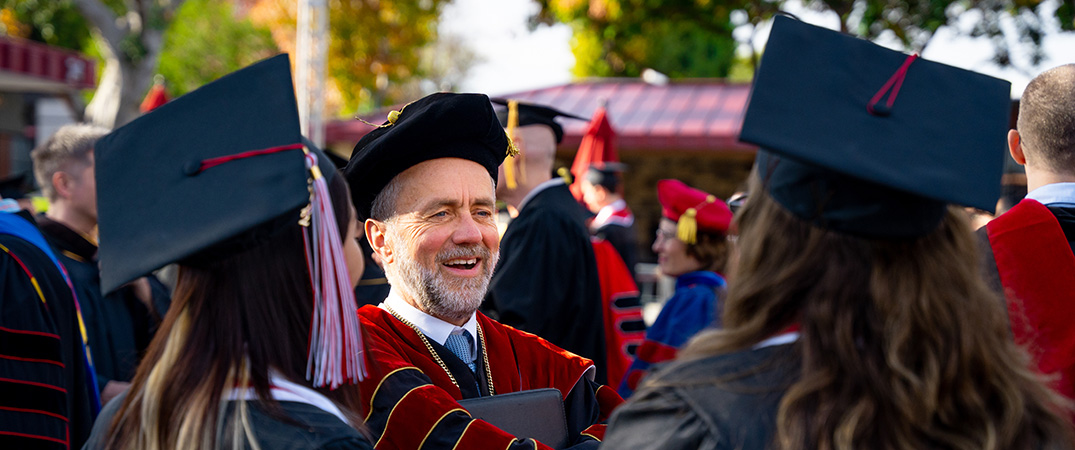
On August 26, 2009, President Corey and the Biola Community welcomed the incoming class of students and faculty. President Corey told the new students that they have joined a student body that has the capacity to change the world. He discussed John 15:7 and how students must abide in the vine and remain in Jesus Christ, therefore making big dreams possible. At the end of this video, Todd Pickett, Associate Dean of Spiritual Development, and Danny Paschall, Dean of Students, share their reflections on Convocation and the upcoming year.
Post Your Comment
Please login first.